Most delays on a small job are decided before a single brick is laid. That’s the uncomfortable truth. I’ve run crews on everything from kitchen knock-throughs to two-storey extensions, and I can count on one hand the jobs that fell behind because of something nobody could have seen coming. The rest slipped because of decisions made in the week before the first delivery arrived. If you’re a small builder or a homeowner managing your own renovation, learning how to avoid delays in construction projects comes down to five causes. Fix those and you’ll dodge the majority of the pain.
1. The Programme That Only Exists in Someone’s Head
Ask most small builders for their programme and they’ll tap their temple. That’s not a programme, it’s a hope. On a job with more than three trades, an unwritten sequence is a delay waiting to happen, because nobody can see what has to happen before what.
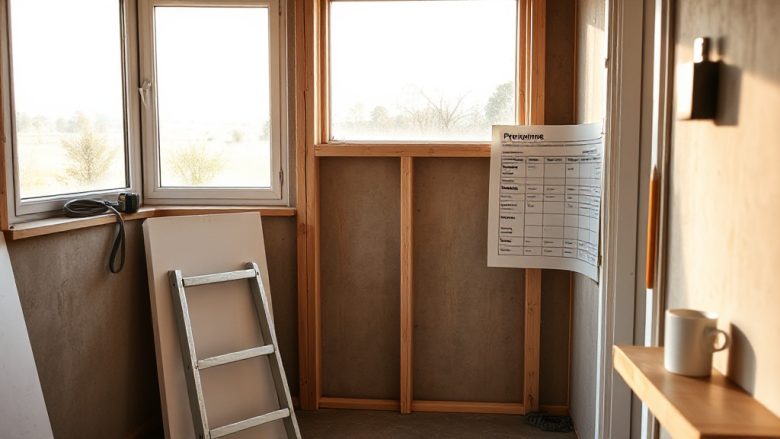
You don’t need project management software. A sheet of A3 taped to the site cabin wall does the job. Write the trades down the left, the weeks across the top, and block out when each one is on site. Then mark the dependencies: first fix electrics before plasterboard, plasterboard before skim, skim dry before second fix. The moment you draw those arrows, you’ll spot the clashes. I’ve caught a plumber and a plasterer booked for the same Thursday more times than I care to admit, purely because the sequence was never written down.
The fix is boring and it works. Build the programme backwards from the handover date, not forwards from today. Working backwards forces you to confront the real critical path instead of the one you’d like to have. Add a full week of float before handover and don’t tell the client it’s there. That week is your shock absorber, and you’ll need it.
2. Materials Ordered Too Late, or Ordered Wrong
Late materials are the single most common cause of slippage I see on domestic jobs. A kitchen that arrives three days late doesn’t cost you three days; it costs you the electrician’s slot, the tiler’s slot, and the decorator’s slot, because none of them can work around a missing carcass. The knock-on effect is brutal.
Order long-lead items the day the job is confirmed, not the week you need them. Windows, bespoke joinery, certain tiles and anything imported should be on order before you start demolition. Get written confirmation of the delivery date, not a verbal “should be about three weeks.” If a supplier won’t commit in writing, treat that as a red flag and find another.
Ordering wrong is just as costly. Measure twice, and check that the item matches the drawing, not the memory of a conversation on site. I once watched a crew stand around for two days because the structural steel had been ordered to the wrong length. The fabricator was good, but two days is two days. Keep a simple materials schedule alongside the programme: item, supplier, order date, confirmed delivery date, and who’s checking it in. One person owns that schedule. If everyone owns it, nobody does.
3. Decisions Made Late by the Client
This one is delicate, because the client is paying, and you don’t want to bully them. But an undecided client is a delayed job. Every week a tile choice sits unmade is a week the tiler can’t be booked with confidence.
Front-load the decisions. Before work starts, sit down and walk through a decision list: finishes, fittings, socket positions, door swings, paint colours, anything that affects a trade’s work. Give each item a deadline tied to the programme, and put those deadlines in writing. Something as simple as a shared document with a date next to each choice works fine.
When a deadline passes, don’t quietly absorb the delay. Flag it the same day, in writing, and explain what it costs in sequence terms. Most clients respond to that. They don’t realise that choosing a tap in week six holds up the plumber who was booked in week four. Make the consequence visible and the decisions tend to arrive on time. Where a client genuinely can’t decide, offer two options and a default. “If I don’t hear by Friday, we go with the second one” moves things along faster than any amount of chasing.
4. Trades Booked Without Slack
Good trades are busy, and that’s exactly why you can’t book them back-to-back with no gap. If the plasterer is due the day after the electrician finishes, and the electrician runs a day over, you’ve lost the plasterer entirely. He’s on another job and he’s not coming back for a fortnight.
Build gaps into the sequence. Two or three days between trades on a small job is not wasted time; it’s insurance. Use the gap to snag the previous trade’s work, get materials moved, or let screed and plaster dry properly. Drying time is real time, and rushing it causes callbacks that cost more than the gap ever would.
Confirm each trade a week out and again the day before. A quick message asking “still on for Tuesday?” has saved me more schedule pain than any software. If someone goes quiet, assume they’re slipping and start ringing around. Don’t wait until the morning they’re due to discover they’ve gone elsewhere. Keep a short list of backup trades for the critical ones: electrician, plumber, plasterer. You won’t need it often, but when you do, it’s the difference between a two-day slip and a two-week one.
5. Variations Handled Verbally
The client asks for an extra socket, or a slightly bigger opening, and you say yes because it’s easier than saying no. Three weeks later the job has grown by a dozen small changes and nobody can remember who agreed to what or what it costs. That’s how a tight job drifts.
Every change gets written down, priced, and signed before the work happens. It doesn’t need to be formal. A one-page variation sheet with a description, a price, and a time impact is enough. The time impact is the bit people skip, and it’s the bit that matters. An extra socket might add two hours of work but three days of resequencing if the walls are already boarded. Write that down.
When a variation lands, update the programme the same day. If it pushes the handover, tell the client immediately, not at the end. Clients forgive delays they were warned about. They don’t forgive delays that appear out of nowhere on the final week. Handling variations properly also protects you commercially, because a signed sheet is evidence if a payment dispute ever arises.
The Weekly Routine That Keeps It on Track
None of the above works without one habit: a fixed weekly review. Same time, same day, every week. Pull the programme off the wall, walk the site, and ask three questions. What slipped this week? What’s at risk next week? What decisions or deliveries do I need to chase today?
That’s it. Twenty minutes, once a week, and you’ll catch most problems while they’re still small enough to fix with a phone call rather than a rewritten schedule. Delays on small construction jobs are rarely dramatic. They’re a hundred tiny oversights stacking up. A weekly routine flattens that stack before it topples. Do it every week, without exception, and you’ll be ahead of most of the trade.